One injury report that starts every state and OSHA deadline clock.
Injury Report Intake for Employers pre-fills the forms and builds your OSHA 300 log, so the safety, HR or operations manager who owns injury reporting always knows what is due, when, and where the rule comes from.
- Join the waitlist · 3-day free trial when the app opens
- You review and file. The product never submits for you.
- No medical records or PHI fields.
Injury reporting today
Several clocks start at once
The moment an employee is hurt, the state first report, California's DWC-1, OSHA's 8-hour and 24-hour reports, the OSHA 301 and Ontario's Form 7 each have their own recipient, form and deadline.
The OSHA record is built by hand
Blank OSHA 300, 300A and 301 forms are filled in by hand, compiled each year and posted from February 1 to April 30.
Recordability calls without a cited reference
Borderline cases get decided from memory or scattered guidance.
Keeping multi-state rules current is a hidden job
The rules live in carrier instructions, state websites and one manager's memory.
The cost of the status quo Modelled estimate, not a cited benchmark
For a 100-employee employer (about 3 recordable cases and about 9 reportable events a year):
- about $1,350/yr of manager time (9 events × 3 hrs × $50 loaded);
- about $500/yr of OSHA 300/300A/301 compilation and posting (10 hrs × $50);
- about $300/yr of expected late-report penalties and rework.
Total about $2,150/yr, scaling to roughly $5,000–$6,000 at 300 employees.
Built for roughly 150–500 employees, multi-site or multi-state. A smaller single-state team can start with a store workbook.
What changes
- 1One injury report that starts every applicable clock from the employer's knowledge date.
- 2A versioned state rule table with a citation and a “last verified” date on every row.
- 3Escalating email alerts to an owner and a backup contact.
- 4OSHA 301 and publicly available state first-report forms, pre-filled for you to review and file.
- 5An OSHA 300 log and 300A that build themselves from decided cases.
- 6Recordability prompts as cited reference. The employer always decides.
- 7A continuous five-year record with an audit trail and rule-version history.
- 8No-login mobile reporting and a first report with live deadlines in the first session.
Features
Knowledge-date clock engine
Versioned, cited rule table
Escalating alerts with a backup contact
Pre-filled forms
A 300 log that builds itself
No-login mobile report link
How it works
Step 1
A supervisor reports from a phone.
A tokenised site link, no login, no PHI.
Step 2
Every applicable clock starts.
State, California, OSHA and Ontario, with working-day and calendar-day deadlines handled correctly.
Step 3
You review, file and record.
You decide recordability and file with the carrier, the state or OSHA. The 300 log builds from your decisions.
What does manual injury reporting cost you?
- Employees on roster
- 250
- Sites
- 3
- States / provinces
- 2
- Reportable events/yr
- 24
- Manager hrs per event
- 3
- Loaded hourly rate
- $50
Estimated annual savings
$390
Example — 250 employees, 3 sites, 2 states, Professional on annual billing. Modelled estimate.
Store workbooks
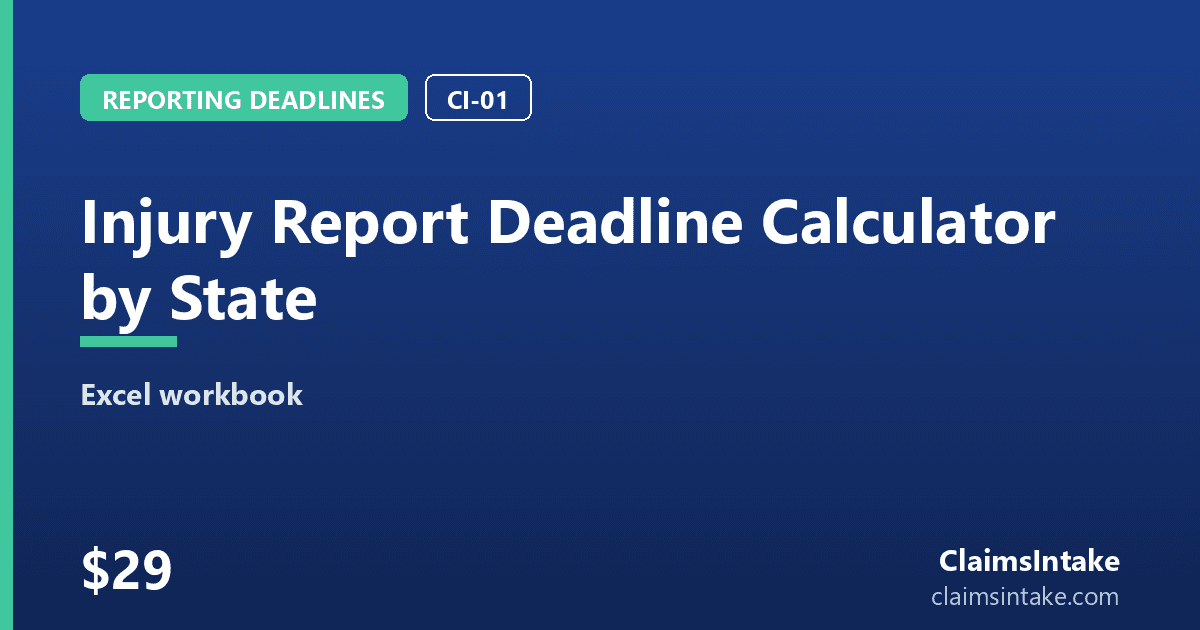
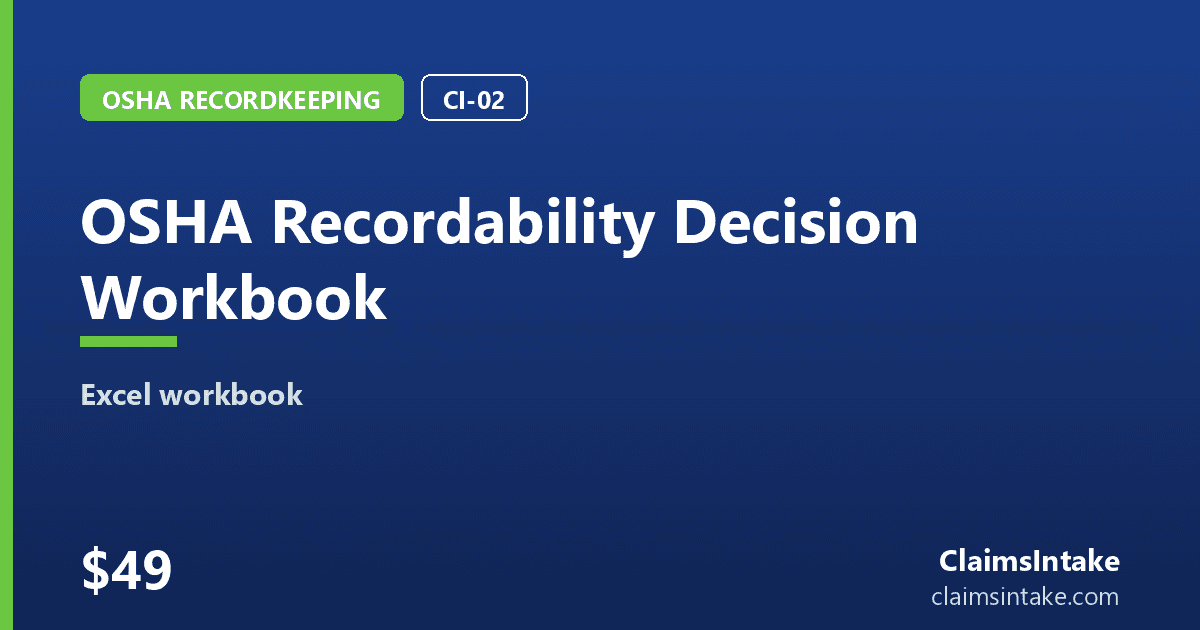
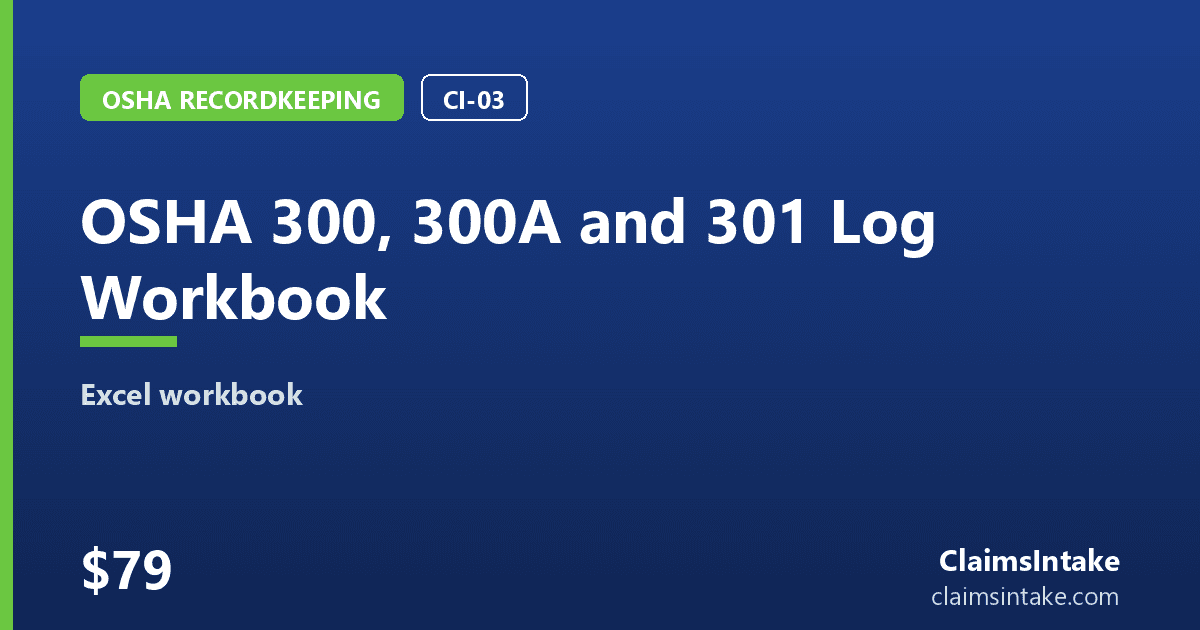
Excel workbooks priced on computed outputs. OSHA and the states publish the blank forms free.
Pricing
Enterprise
Starting at $1,199/mo
Unlimited sites, employees and seats
- 12 launch jurisdictions
- 12launch jurisdictions
- 5-year record
- 5-yearrecord
- 1 knowledge date, every clock
- 1knowledge date, every clock
- 3-day free trial
- 3-dayfree trial